Hey guys wassup, its me Danny007Boy, aka Debargha Malakar. I am a College Student, but also a Game Streamer and Youtuber , i hope u like my posts as i try something new out of these blogs. See ya .
I’ll write about Technology and Gaming related posts!
So if your interested do follow to check them out…! 😉
The latest version of the iPhone’s operating system focuses on customization. That includes an updated lock screen with selectable fonts and colors, Apple Watch-style widgets and rotating photos. Notifications will also roll in from the bottom of the screen to keep them from obscuring your photo, and Live Activities like music playback can expand to fill the lock screen.
Messages will allow editing, undoing sends and marking messages unread. SharePlay is improved for easier sharing within FaceTime and Messages. Dictation blends with text and touch on the fly so you can use any input type at any time. Similarly, Live Text (Apple’s answer to Google Lens) expands to video, letting you pause on any frame and interact or grab text from the video.
Apple says it will be able to smartly extract images from a background and automatically paste them into apps like Messages.
Changes to Wallet include more partners for wireless keys, such as car manufacturers, tap-to-pay on iPhone for contactless payments and Apple Pay Later, which splits the cost of a purchase across four payments.
MacBook Air and MacBook Pro 13
For the first time in ages, Apple has redesigned the Air, and it’s with the M2 chip in mind. It’s still an aluminum unibody, but now it’s uniformly thin at 11mm and weighs 2.7 pounds. Plus, new colors! MagSafe returns, leaving your two Thunderbolt ports available, and it retains an audio jack. It finally gets an upgrade to a 13.6-inch Liquid Retina display, with 500 nits max brightness and P3 gamut. A 1080p webcam brings it up to parity with its siblings, along with a quad-speaker system (with Spatial Audio support) and three-mic array.
Thanks to the improved GPU in the M2 and a focus on performance per watt, Apple says the Air delivers the same battery life and better performance. It finally supports fast-charging, and the new adapter has a second USB-C port.
The 13-inch MacBook Pro also gets the M2 chip, with better performance thanks to an active cooling system. It hasn’t been redesigned, though.
The MacBook Air starts at $1,199 (£1,249, AU$1,899). The MacBook Pro starts at $1,299 (£1,349, AU$1,999). They both start shipping next month, and both offer a $100 discount for students and educators.
Apple’s keeping the M1 MacBook Air around as well, offering a sub-$1,000 computer ($999, £999, AU$1,499), again with a $100 education discount.
MacOS Ventura
Window management with grouping improves in Stage Manager, which also includes drag-and-drop multitasking. Better Spotlight searching incorporates sports and web image search, full-window search results and more detailed info on music and movies. (In iOS, Spotlight moves to the home screen.)
Search within Mail adds instant suggestions and synonyms, also on mobile. It naturally receives the same updates as iOS for Messages. Safari’s Shared Tab Groups mean you can send friends and family your latest shopping picks. Goodbye passwords and hello Passkeys — Touch ID and Face ID come to Safari for logging into sites. Also on iPhone, iPad and Apple TV, naturally.
Improvements in its Metal graphics API include MetalFX upscaling for faster game rendering and added API for faster loading of game assets. Resident Evil Village and No Man’s Sky are getting ported to the Mac for the first time; Resident Evil Village is coming later this year.
Handoff comes to FaceTime so you can jump from device to device, and Continuity Camera finally lets you use your iPhone camera as your webcam. It will support a split view for straight ahead and desktop views.
WatchOS 9
New watch faces are on the way, including more diverse calendars, the ability to pin apps at the top of the dock, new banner notifications and support for Podcasts for kids with parental controls.
For working out, WatchOS 9 gets a lot more detailed about your running metrics — for instance, tracking how you move up or down to track your form. A new multisport workout can switch between swimming, cycling and running for the appropriate workout and tracking data.
Sleep Stages uses the accelerometer and heart-rate sensor to track what sleep states you’re in and time them. The Watch will be able to track atrial fibrillation history, once it receives clearance from the Food and Drug Administration. Tracking medications in the Health app becomes a little more granular and lets you schedule reminders, so it sounds like a typical full-featured medication app.
iPadOS 16
The iPad gets the same updates as iOS 16 as well as a new Weather app. In-OS collaboration allows shared document editing and tab groups, launchable from FaceTime, with update notifications via Messages.
We also got a sneak peek at the Freeform app, a virtual shared whiteboard with drawing tools for group meetings, coming later this year. It supports embedding documents, videos and images, and will be included with all platforms.
Like Ventura, iPadOS gets the new Metal API update for gaming, plus it gets background downloading. Game Center adds Activity rivers, and SharePlay (coming later this year, as well as to iOS and iPadOS) will allow group play.
There are a bunch of tweaks to the interface and capabilities to give iPadOS more desktoplike power. It also adds reference color (Reference Mode) for consistent color matching across devices (personal yay!).
On M1-based iPads, you’ll be able to increase the display’s pixel density to fit more on the screen and use virtual memory. And iPadOS, like Ventura, gets Stage Manager, for a far better multiwindow task-switching experience. When you connect to an external display, it takes better advantage of the second screen via Stage Manager and makes it a little more seamless to use touch and Apple Pencil with a Mac.
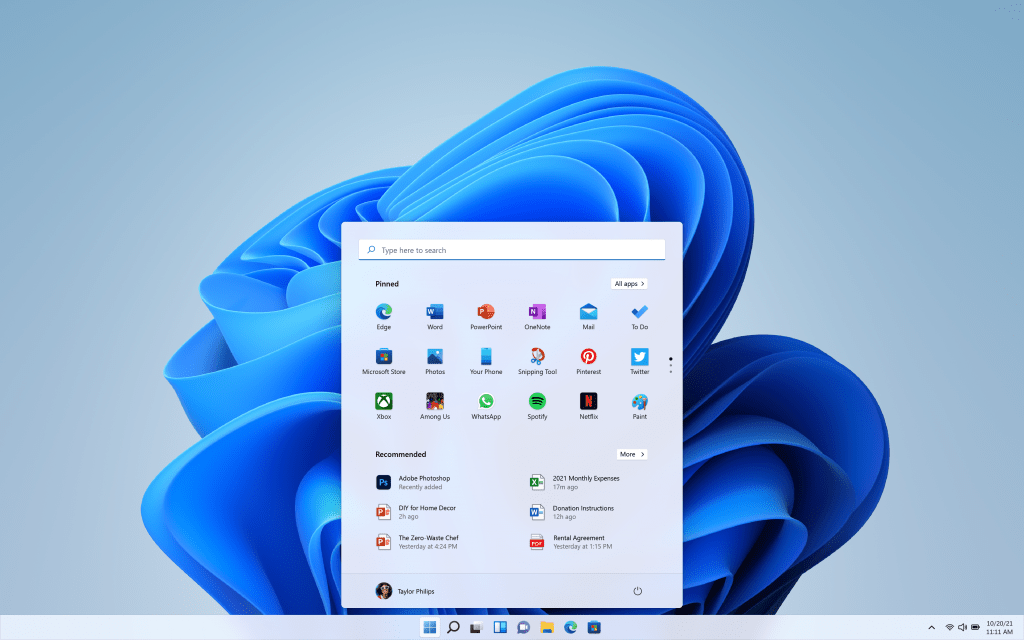
Windows 11 is officially revealed by Microsoft as a part of their event and it’s lot fresh from its old predecessor. After it’s failure with Windows 8, Microsoft had stuck with Windows 10 for quite some time but now they are coming up with the new “fresh” Windows 11. Windows 11 will be available to download for the users later this holiday season, i.e during November and will be free upgrade for all the current Original Windows 10 user. Windows 11 got new wallpapers, a new taskbar and a completely new Start Button. There are new round corners, sweet little animations and lots more. They have also brought widgets but it’s not like Win 7 anymore. Widows 11 widgets is a slide to add a new tab which gives you more insights to tabs you wanna check out. The looks are dope though. Windows 11 got some great aesthetic wallpapers and the whole file explorer looks different. The Start button is center focused but obviously can be changed and some tweaks with the icons on the taskbar. Windows 11 is also to be coming with support for Android apps and it’s own new app store in collaboration with Amazon. Thus it’s time to say goodbye to third party apps such as Bluestacks. Although there is a bummer, which is it won’t support CPU which are older than 2017 or are not TP02.0 or doesn’t have min 2 cores and 2GB RAM. Thus majority computers misses outs on the update unless you go shopping for some better hardware.
This is the first time Xiaomi has ventured into the PC component space. The new Redmi Display 1A has a 23.8-inch full-HD IPS LCD panel. It has very thin bezels on three sides with the bottom chin being comparatively thicker. Xiaomi claims that the monitor is 7.3mm at its thinnest point. The monitor has a 178-degree field of view and is TUV Rheinland-certified for low blue light emissions.
The Redmi Display 1A has 16:9 aspect ratio, 60Hz refresh rate, 250cd/m² brightness, 1000: 1 contrast ratio and 6ms response time. This monitor also carries 3 years of warranty. It has a power button and power inlet port at the back along with VGA and HDMI ports. Since the monitor has thin bezels, Xiaomi suggests that it can be used for a multi-monitor setup.
Xiaomi Mi Box 4K streaming device on Friday made its debut in India, as a part of the company’s online launch event. The Mi Box 4K is a standalone Android TV 9 Pie-powered device that plugs into your existing television through the HDMI port. The device is Wi-Fi enabled for connectivity, and gives users access to a variety of apps and services available on Android TV, including popular streaming services such as Netflix, Amazon Prime Video, Disney+ Hotstar, and more.
Xiaomi Mi Box 4K price is set at Rs. 3,499. It will go on sale for the first time on May 10 at 12pm (noon) via Flipkart, mi.com, Mi Home stores, and Mi Studio stores. It will also soon reach the Xiaomi partner offline stores. Xiaomi has partnered with Docubay, Epic, HoiChoi, and Shemaroo to provide exciting offers to Mi Box 4K buyers. Alongside the Mi Box 4K, Xiaomi also launched the Mi True Wireless Earphones 2 and Mi 10 5G in India today.
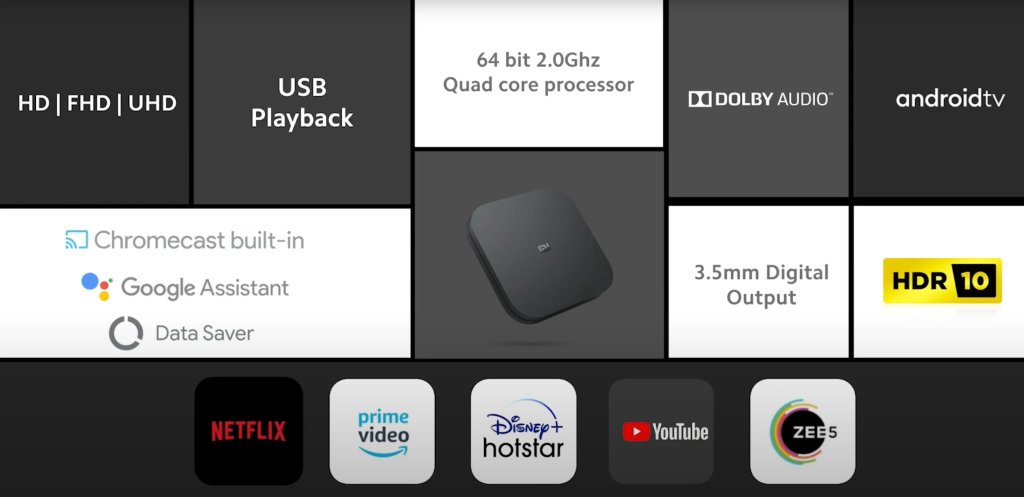
The Mi TV Box 4K is designed to be placed on a table-top, and is connected to the TV using an included HDMI cable. The device is powered by a quad-core Amlogic processor, and features 2GB of RAM and 8GB of internal storage for apps. Up to 4K streaming on supported content platforms is supported, along with the HDR10 format. The device will be capable of playing 4K and HDR content from streaming platforms supporting these formats, such as Netflix and Amazon Prime Video.
Unlike Xiaomi’s range of televisions, which run on the company’s PatchWall interface, the Mi Box 4K will only run the stock Android TV interface. As the device is being targeted at advanced users who usually know what they’re looking for, PatchWall’s content discovery-based features have been left out of this device.
Users will get additional connectivity on the Mi Box 4K through a USB port and 3.5mm digital out socket, as well as Bluetooth to connect headphones or wireless speakers for sound. The presence of the USB port allows the device to be used as a local media player, and there is wide support for various video and audio file formats. There is also built-in Chromecast Ultra on the device, allowing users to cast content at up to 4K resolution. It will go on sale on 10 May (Flipkart and Mi.com).
Xiaomi once again faces allegations that it is silently sending user data to remote servers. Security researchers claim that the Chinese company, which leads the smartphone market in India and is amongst the top-five smartphone makers globally, has provided loopholes on its phones to transmit data to remote servers hosted by Alibaba. Amongst other preloaded apps, the default Web browser on Xiaomi’s Redmi and Mi series phones were found recording Web history of users even when switched to “incognito” mode. Xiaomi has denied the claims, and added that while it tracks some anonymous browsing data, it does not share this with third-parties.
Security researchers Gabi Cirlig and Andrew Tierney were able to spot various backdoors in Xiaomi phones that help the company obtain user data, without getting any consent from its users, reported Forbes. Cirlig discovered that his Redmi Note 8 was “watching much of what he was doing on his phone” and was sending all that data to remote servers hosted by Alibaba.
The researcher said that his identity and his private life were being exposed through the loopholes that Xiaomi seems to have intentionally added to the software available on the Redmi phone. Further, he was able to find that the company was recording details even when he was browsing the Web on his phone using the incognito mode. In addition to the browsing data, Cirlig’s Redmi Note 8 was allegedly recording what folders he opened and which screens he swiped. This includes the status bar and the settings page. All that data is said to have been transported to remote servers located in Singapore and Russia, hosted by the Web domains registered in Beijing, where Xiaomi has its headquarters.
Cirlig found that the security flaws weren’t limited to his Redmi Note 8 and according to him, exist across various Xiaomi phones. He was able to confirm their existence by downloading the firmware for the Mi 10, Redmi K20, and Mi Mix 3. Like Cirlig, Tierney also found Xiaomi’s that browsers available for down on Google Play — Mi Browser Pro and Mi Browser — were collecting the same user data. Both browsers have over 15 million downloads, as per the stats on Google Play.
Xiaomi appears to use the data it acquires from users to understand their behaviour. The company has already partnered with behavioural analytics startup Sensors Analytics that could help understand how people are using smartphones. Both Cirlig and Tierney found Xiaomi apps were sending user data to domains that apparently have references to Sensor Analytics.
Xiaomi has denied the issues raised by the security researcher. Responding to Forbes, Xiaomi said, “The research claims are untrue.” It also stated that privacy and security are of “top concern.” Further, the company said that it doesn’t collect information in the incognito mode, though it did mention that it records “anonymous browsing data” to improve the user experience. A Xiaomi spokesperson also confirmed to Forbes the relationship with Sensor Analytics for using a data analysis solution to collect “anonymous data stored on Xiaomi’s own servers.” However, the company claims that the data isn’t shared with the startup or any other third parties.
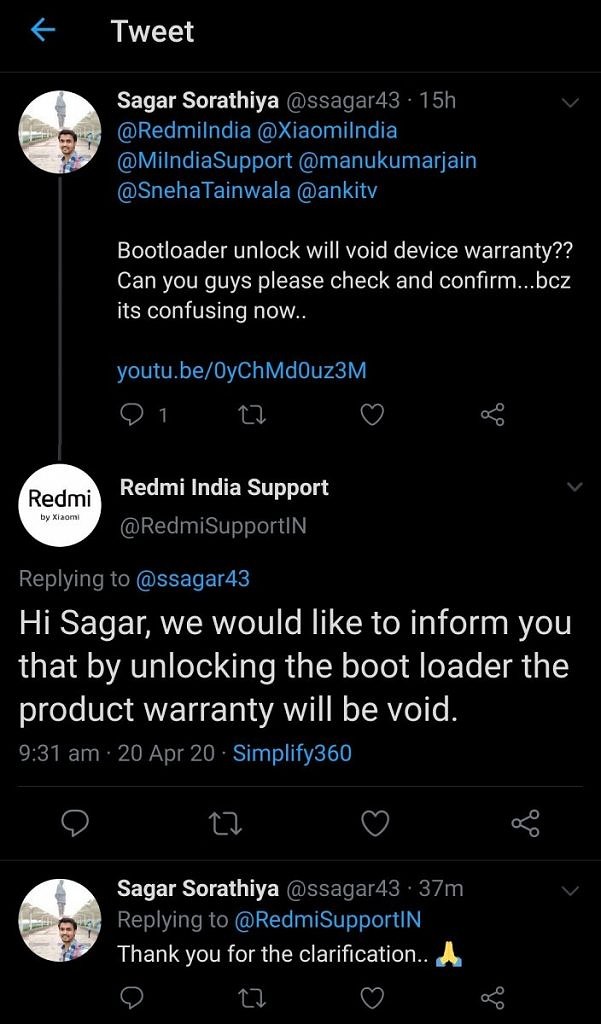
Unlocking of the bootloader is made available to make sure that MIUI developer ROMs can be tested by users and will be covered under warranty.
Bootloader unlocking does not inherently void your hardware warranty. But a case where the unlocking results in a brick which cannot be fixed via software, the warranty will be void.”
Xiaomi India spokesperson.
As the statement explicitly says, the warranty remains intact so long as a software fix can work on the bootloader unlocked phone. By extension, if you hard brick your device and it needs a hardware fix to be brought back to life, perhaps in the form of EDL pin-shorting or worse, a motherboard replacement, you will be out of luck and warranty. If any software fixes are needed, Xiaomi India will charge you a nominal amount (currently ₹150 plus taxes) under the general maintenance clause in the official warranty, in order to revert your phone back to the stable ROM available for the phone in that region.
This policy is applicable to Xiaomi phones in India under both the Mi and Redmi sub-brand. Other regions could possibly have variations to this policy. And before you ask, POCO is excluded from the scope of this article and this policy entirely as it operates as an independent unit and has its own separate policy.
After deleting the tweet, Xiaomi also updated their statement with a fresh response:
Hi, we would like to inform you that by just unlocking the bootloader your device warranty will not be void. However, if the device crashes/bricks due to Custom ROM the device will be serviced out of Warranty. We would strongly recommend you to continue use your device with MIUI.
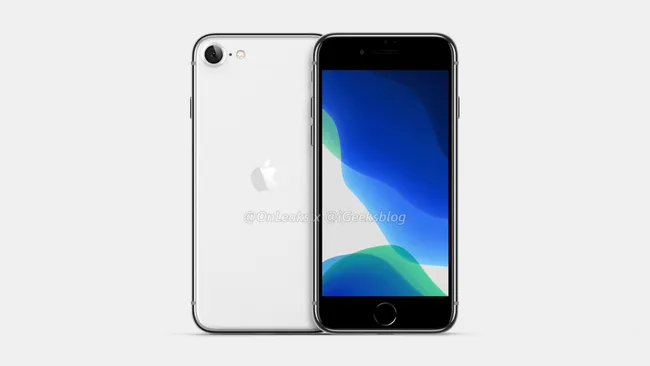
Apple has officially announced the new iPhone SE, a lower-cost iPhone that starts at $399 for a version with 64GB of storage. It has the same basic shape and look as the iPhone 8, which means it has a 4.7-inch screen, large bezels on the top and bottom, and a home button with Touch ID. It’s a design that has stayed consistent since the iPhone 6, which makes the iPhone SE essentially the fifth generation of that same look. Apple knows this design well. It would also have 128 and 256 GB variants.
It is available for preorder this Friday, April 17th, and it will ship on April 24th. There will be a 128GB model offered for $449 and a 256GB model for $549. Like other iPhones, it will come with a free year of Apple TV Plus. It will come in black, white, and Product Red.
The iPhone SE is essentially an iPhone 8 with a better camera and processor — and a lower price tag. Although it’s a relatively old design, this iPhone SE has Apple’s A13 Bionic chip, the same that’s available in the latest iPhone 11 and 11 Pro models.
There’s a single 12-megapixel camera lens on the back (along with a flash). Apple says it’s using the A13 Bionic’s chips to improve its Smart HDR photography, which combines multiple shots into a single photo to improve lighting and detail.
It also has a portrait mode with technology Apple calls “monocular depth sensing.” It uses machine learning to detect depth and faces — which, unfortunately, means that it will only work on people, not pets. It includes optical image stabilization, and Apple says it can do “cinematic” stabilization on video as well as support 4K video at 60fps. The front-facing selfie camera is 7-megapixels, and it can also do portrait mode effects.
It only comes with a dinky 5W charger in the box, though it can support 18W fast charging if you have the right adapter. It uses a Lightning connector for charging, of course, and it will also support Qi wireless charging. There is no headphone jack, but it will come with Lightning headphones in the box.
The OnePlus 8 is available at a starting price of $699 for its 8GB RAM And 128GB internal storage, and $799 for its 12GB RAM and 256GB internal storage. On the other hand, the OnePlus 8 Pro with 8GB RAM and 128 GB internal storage is available for $899 and the 12GB RAM with 256GB internal storage variant retails $999.
The OnePlus 8 supports a 6.55-inch full-HD+ Super AMOLED display, while the OnePlus 8 Pro comes with 6.78-inch QHD+ Super Fluid AMOLED. With the same Snapdragon 865 SoC processor on both the smartphones, the OnePlus 8 series comes with 12GB of RAM and 256GB of internal storage as well.
Coming to the cameras, the OnePlus 8 Pro has a quad-camera setup with two 48 MP sensors, one of them for ultra-wide shots an 8MP secondary sensor, along with a 5MP sensor as well. On the front, the device houses a 16MP selfie camera with AI features a plethora of other modes.
On the other hand, the OnePlus 8 houses a triple-camera setup with one 48MP primary sensor, a 16MP secondary sensor as well as a 2MP sensor. The selfie camera specifications remain the same as the OnePlus 8 Pro.
One of the other major highlights of the series is the powerful battery. The OnePlus 8 Pro houses a 4510 mAh battery and the OnePlus 8 comes with 4.300 mAh capacity. Bith the smaryphones also come with 30W Warp Charge 30T technology. This essentially means that the smartphones can charge with the company’s proprietary wireless charger up to 30W. OnePlus has claimed that the wireless charger will be able to charge the phone from 0 to 50% in 30 minutes. The smartphone also comes with IP certification for dust and water proofing, a first for OnePlus.
The new iPhone 9 (iPhone SE 2020) could be the most important iPhone of 2020.
The iPhone 9 is expected to start at just $399 and deliver most of the features people need. And now we think we know when Apple’s iPhone SE successor will be launching.
The iPhone 9 will reportedly feature the same size display as the iPhone 8 at 4.7 inches. That’s not big, but there’s still plenty of folks out there who prefer small phones. The new iPhone SE will also pack Apple’s fast A13 Bionic chip, so it should offer the same performance as the iPhone 11 for hundreds less.
Unlike the iPhone 11, the iPhone 9/iPhone SE 2020 is expected to feature a Touch ID button instead of Face ID. iPhone 9 will feature a single rear camera and not offer a wide-angle lens like the iPhone 11 or a third telephoto lens like the iPhone 11 Pro and iPhone 11 Pro Max.
The iPhone 9 will come in three simple colors: white, black and red.
Last month, Adobe announced that it is building its own camera app, complete with AI-powered filters and the Photoshop branding. Adobe Photoshop Camera claimed to make use of Adobe’s artificial intelligence platform Sensei to recognize subjects in photos, and then suggest filters that can be applied. These filters can also be applied in real-time and be previewed through the viewfinder, or be applied to existing images in the media gallery
Adobe Photoshop Camera requires Android 9+ to run. The following devices are said to be officially supported:
Google Pixel3/XL
Google Pixel4/XL
Samsung S9/S9+
Samsung S10/S10+
Samsung Note 9
Samsung Note 10/10+
Although it works perfectly with Redmi device, Realme devices, Lenovo devices and others also







 The Techipedia